

This is the last blog in a series concerning document D1-PH/1, a book of astrological prophecies that has been filled with notes by a doctor from Wareham named Nathaniel Bartlett.
In this blog we will be looking at what the notes tell us about Nathaniel’s patients and his treatments.
There are around 250 patients named in the notebook. Some of these only have a single entry whilst others have entries for treatments stretching over a number of months.
A few of the entries record the place where the patient lived, showing that Bartlett treated patients from across the Purbeck area, with locations ranging from Swanage to Bere Regis and Lulworth. There is also a single entry for Sarah Newman of Dorchester.
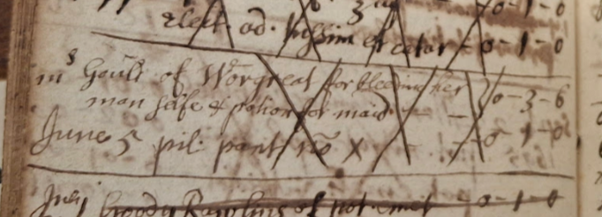
Some of the places such as Hethfelton and Dunshay are Manor Houses and many of the patients seem to be the local gentry and prosperous farmers. These patients did not only pay Nathaniel to care for themselves and their families, but also to care for their servants as shown by entries such as “Maid of Mr White of Hefleton” and “Man of Farmer Brown”.
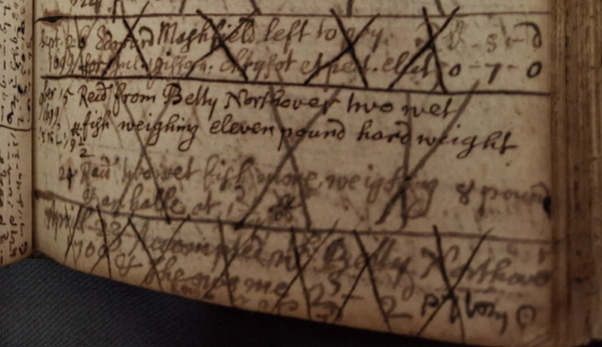
Not all of Nathaniel’s patients were from the higher levels of society. This is reflected in entries such as the one from 15th September 1699 recording “Rec’d from Betty Northover two wet fish weighing eleven pound hard weight” there are also entries recording him receiving butter from Goody Tarrant and receiving in gardening 2 shillings from Goody Pranket in lieu of monetary payment.
Abbreviations of Latin terms are used to record the medicines and procedures that Nathaniel administered and we do not have any medical knowledge, so it is not always easy to work out what conditions were being treated.
Many of the entries in the volume record payments for gargles, potions, cordials and pills. There are also a lot of incidents where the patients have been bled, an entry for having ears syringed and some where they are just being charged for a visit.
There is one entry where the treatment is written out more fully allowing us to work out the patient’s circumstances. The entry from August 23rd 1695 is written in latin and translates as “For Elizabeth Chisman who was in childbirth and on pain of death through immoderate blood loss”. The word for childbirth has later been crossed out and replaced with “abortiente” so the baby seems not to have survived.
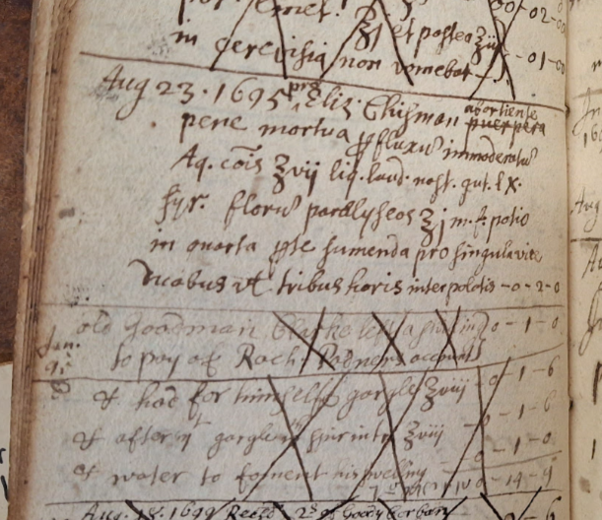
The treatment prescribed is harder to read, but it appears to be some medicine and something that has to be smoked every three hours.
This entry is one of the few in the book that has not been crossed through, which makes us wonder if Elizabeth did not survive to pay her bill.
One of the most intriguing entries is an undated entry that was probably from 1699 for “The young woman of Beer”. There is little information in the entry that could help us understand why the name of this patient is not recorded. Perhaps Nathaniel didn’t know it, or perhaps he had a reason for keeping her anonymous.
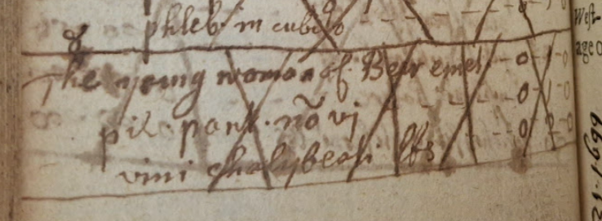
We think that the abbreviations in the book show that this young woman was given an emetic to induce vomiting, some sort of pill, possibly for her stomach or bowels, and some “Vini Chalybealis”, wine infused with steel filings that was thought to have fortifying properties. It is possible that the young woman was suffering from stomach complaints, but it may also have been a menstrual issue as these treatments were sometimes used to treat an ailment known as green sickness.
Green sickness or Cholorosis, often referred to as “the disease of virgins”, was a condition that was commonly diagnosed from roughly the mid-1500s right up until the early 1900s, although descriptions of symptoms, causes and treatments varied greatly over this period. It was widely believed to affect young women and girls who and there are mentions of the conditions in several of Shakespeare’s plays.
Around the time when Nathaniel was practicing symptoms were thought to include paleness or off colour skin, dizziness, heart palpitations, cravings for unnatural food and the stopping of periods. These symptoms were widely believed to be caused by women having too much sticky blood that was causing blockages. This became a particular problem in growing girls because the amount of blood increased as they grew and their vessels may be closed or not large enough to let the blood through. The most effective cure was believed to be getting a husband and getting pregnant. If this was not an option a mixture of purging, blood letting, ‘cold’ foods such as onions and bed rest could be prescribed.
This is just speculation and we will never know who the young woman of Beer was, what ailed her or whether Dr Bartlett’s treatments helped her, but the account book is a fascinating and useful source of information about the inhabitants of Wareham and the practice of medicine at the beginning of the 18th century.
—
If you are interested in hearing more about this tale, join us for November’s From the Stacks session, on Wednesday 25 November at 12.30pm, where one of the team will be talking about this almanack and the stories it has uncovered.
From the Stacks is our free monthly talk, lasting up-to 30 minutes so as to fit into lunchbreak! We look forward to welcoming you later in the month.