

In February I was given the following challenge statement with a view to doing some initial discovery work around our current Newsroom, its environment, and how it could link to our new customer platform which is currently being developed.
“To design and develop a new online newsroom, which shares all the council’s news stories, communications, campaign messaging and blog posts to external audiences, including residents and journalists, in an engaging and accessible format, with the aim of ensuring people are well informed about what the council does”.
As part of the customer platform work, we are looking for ways that we can build better online services for our customers. Earlier this year, we successfully migrated the Dorset Council website onto the platform, which was closely followed by the migration of the Public Health Dorset website and then the creation of a new website for Fostering. The content on these sites is relatively static, with few updates required. However, when it comes to our Newsroom and Blog pages we needed to find ways in which we could build these into the platform whilst supporting their ever-changing need for fluid content.
The Newsroom is managed by the communications team and provides easy access to the council’s latest news and blogs, media contact information, e-newsletter sign up and news archive.
Discovery
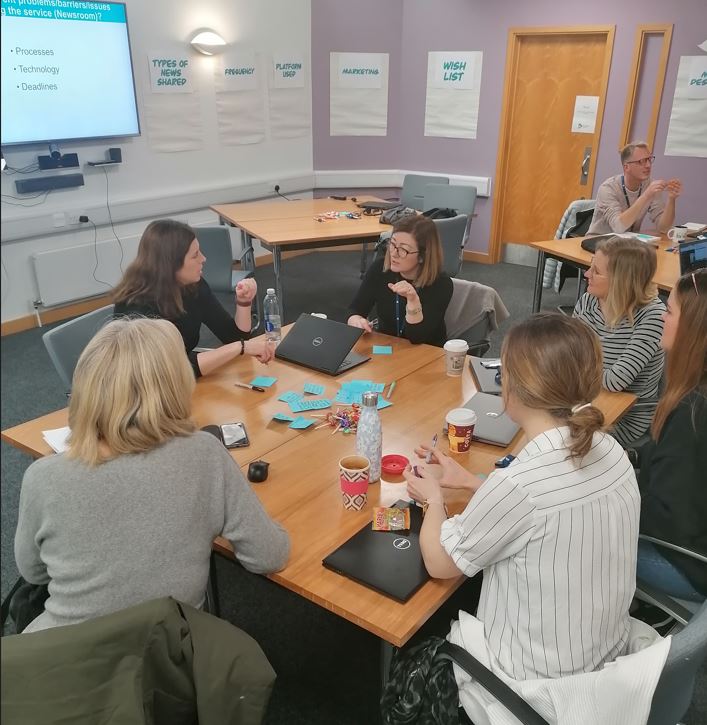 To kick off discovery, I first needed to understand more about the ‘as-is situation’ for the current newsroom process so I held a real life, face to face workshop – seems so novel now we mostly work in a virtual environment, but I find these sessions are so fruitful with people in a room, often just talking things through. The communications team attended with the objective to understand current processes, pinch points, and get a feel for how the newsroom currently performs.
As-is process mapping
I am always fascinated by talking to services about their processes and understanding where I can highlight potential efficiencies and savings. I took time observing the communications team to understand how they publish news stories, this type of research is so helpful to really understand how people work/behave.
It showed that due to using systems for different purposes, which are not integrated, the process is both time and labour intensive. Not only is this an inefficient use of resources, but it also is not sustainable in the long-term for the service or its performance.
Service design is about looking at things outside in, viewing from the customers perspective so my next activity was to talk to users of the newsroom service. To understand the user experience from a range of audiences, I set up a number of interviews.
Interviews
In Dorset, we have a “People’s Panel” of residents who are interested in helping to shape the council’s policies and activities through our consultations. We try in general, to avoid sending surveys out to our customers but I found there was a lack of documented evidence about the experiences people have of the newsroom service.
I sent out a survey to the panel and conducted a series of interviews, speaking to residents and colleagues across the council as services work closely with our communications team when it comes to news articles, notifications, features, and announcements.
I learnt that
- Not everyone is aware of the newsrooms existence
- People want to hear more broadly about the work of the council and not just success stories
- Some members of the public may not be able to access the newsroom online for a variety of reasons
- Internal colleagues are happy with the support they receive from communications to publish news
- The process for internal colleagues is efficient to request the publication of news
The communications team were able to provide some analytics on the newsroom content and social media engagement levels. We discovered that our busiest month for news articles and press releases is December, and the majority of interactions come from social media posts which are read on average between 10 am and 7 pm each day with very little interaction on either side of this.
The user research and data have enabled me to baseline the communications team’s performance and we can now use this data to create new key performance indicators for the team moving forward.
“I am 87 and I manage online, but I am aware that others don’t and it’s a problem”
“I look at the council website, I didn’t know about the newsroom”
What do others do
From our early insights and learnings, we began to think about how we might prototype the newsroom landing page based on our hypotheses and feedback from users. Feedback from user interviews was interesting, there was no desire to change the current design and the overall feel was that the layout was good. I checked out other councils’ newsrooms and media centres to see how our site compared.
Define
Synthesising the insights
When I was happy that I had gathered enough insight about our current Newsroom service and user experience, it was time to consider the themes coming out of the discovery phase. To do this, I needed a big wall and a load of post-it notes. This formulated the basis for our problem statements and we created 14 as a result.
Problem statement prioritisation
The team prioritised the problem statements by voting on them. The problem statement below had an overwhelming number of votes and I was able to demonstrate, that if we could solve this first, it would address eight subsequent problem statements.
| What is the Problem? | What is the consequence? | How might we… |
| There is no integration between WordPress Orlo, PRGloo and Mailchimp | This leads to double entry and time delays, frustration in the team and in some cases, some of the articles are unintentionally not published across all platforms to save time due to work arounds | How might we make it so that members of the Communications team create one instance of an article and for it to be published across all platforms in one transaction to avoid repetition and possible human error? |
After the initial discovery period, high level technical feasibility showed it would be possible to deliver the newsroom as part of the customer platform and the broader council website and customer account.
Develop
User stories session
We set about creating user stories to frame our requirements and break these down into tasks. I held a workshop with the team to capture them on a prioritised requirements list (PRL).
The PRL details information that is crucial to the project being a success. When we captured the requirements, we prioritised them to understand the project dependencies and what the potential ‘show stoppers’ could be, this was shared with all stakeholders including ICT development team, Subject matter experts, product owner, project sponsor and the project manager.
Valuable lessons were learnt from the PRL work. There needs to be transparency, visibility and a good understanding of every one of the requirements, moving forward it was agreed to bring in our ICT colleagues at an earlier stage so they have full sight of the PRL and can highlight any potential queries to deal with in a timely manner with better collaboration. We don’t have dedicated multi-disciplinary teams/resources working on the platform project due to the demand/capacity across the wider portfolio of change work.
We want to involve everyone, working in the open and being transparent with everything we do, at every stage of the process.
Action plan
We created an action plan of how we would work together and the tasks required to progress the development. As with all councils, resource is a precious commodity at Dorset and our ICT development operations team are working at capacity, so it’s really difficult to timebox our work. Instead, we agreed to sequence our work so there is less emphasis on time and more emphasis on priorities/themes.
The team agreed to concentrate on the ‘creation’ of the new newsroom and how we would build this as an integral part of the customer platform, followed by making the creation of news stories more efficient. The platform has some ‘out-of-the-box functionality so as a team, the decision was made to create a minimum viable product (MVP) using existing functionality.
Working alpha – MVP
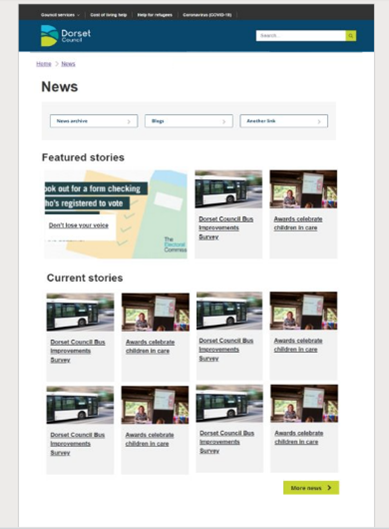
We have a working alpha presented in our latest show and share it, it’s been received positively by our communications team. We will continue to add functionality and then undertake user testing to create something that will be better for our residents and staff.
Next steps
As we move into the next phase of the project, we will work with services to understand how they can be onboarded onto the platform, and continue to develop our skills and knowledge in Liferay and Digital Place to be able to exploit this new technology.
This blog has been written by Vicky Mears, a Service Designer for Dorset Council.
“I have been working in the Transformation, Innovation and Digital team since February 2020 and I have a particular interest in users and user research”.
