Frday feedback

Feedback Friday: How training has helped a local authority Occupational Therapist

It’s always great to receive positive feedback on how training can enhance confidence. Here’s some comments from Bournemouth Christchurch and Poole Occupational Therapist Jeremy:

“The reason for me doing the course is to make use of DCR at work, where it will save a lot of time waiting for responses from queries to GP surgeries.

“In this respect, I must be able to use it and understand everything about data protection and information sharing.

“This course provided an excellent start on which to base my use in practice, so I don’t contravene any laws, upset patients or get into serious trouble.”

Full case study coming soon.
Engagement at the Dorset Care Record

We’ve created a short photo montage set to music showing some of our engagement work with partners, local and national stakeholders over recent months.

At the DCR we strongly believe that engagement is vital to help everyone understand how data can save lives, and we have now conducted more than 200 events across the county since our inception.

Catch our video on our You Tube channel

What’s in the DCR and what’s coming

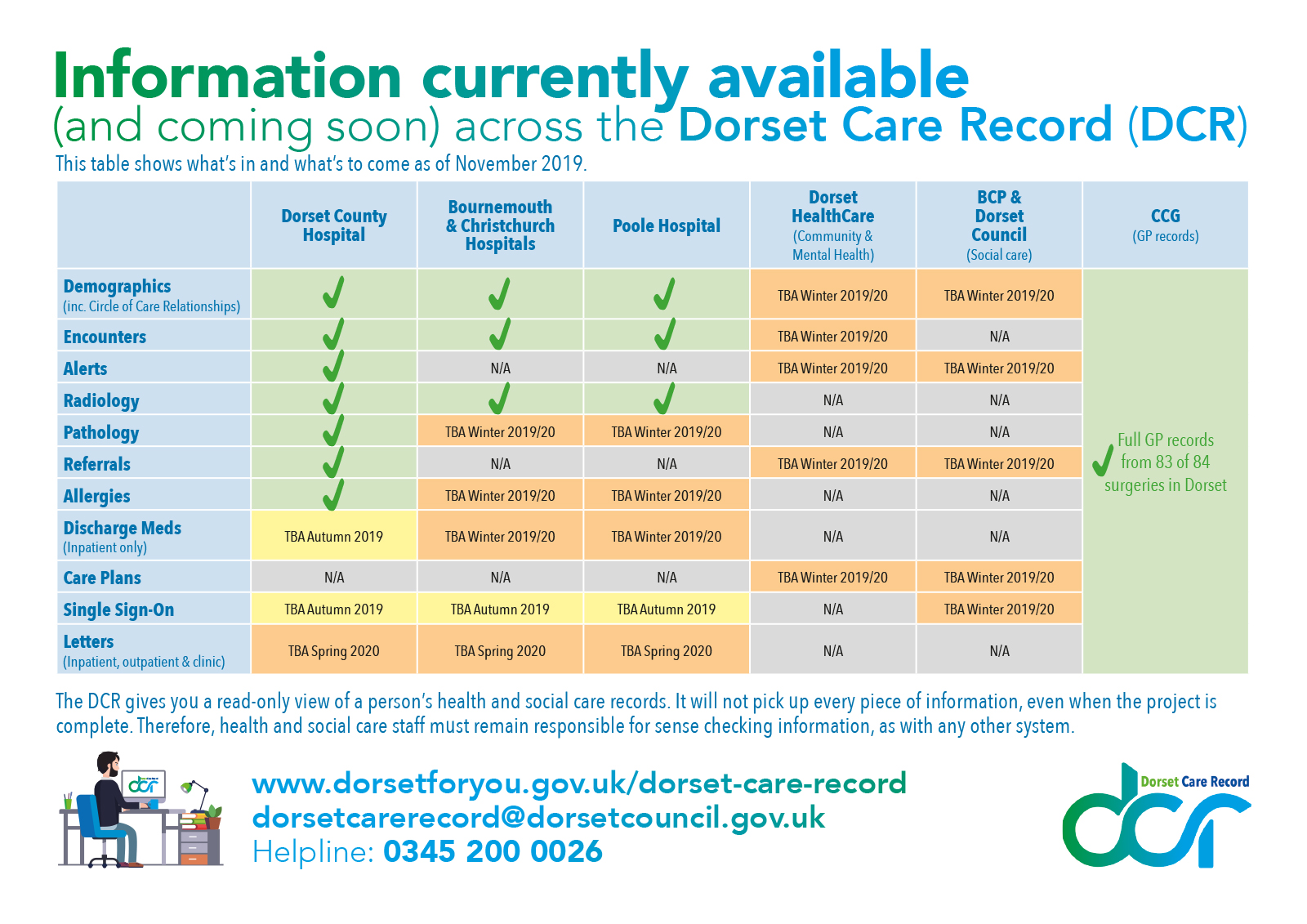
The diagram shows the current feeds available in the Dorset Care Record and what is coming up in the next few weeks and months of 2020.

Latest developments include the successful integration of the collaborative worklists feed into the DCR. Collaborative Worklists enable a multidisciplinary approach to coordinated care. Patients, stratified by common characteristics, can be added to a list that is shared by one or more users – clinicians, administrators, case managers, or coordinators who have responsibility for reviewing, working and managing that patient population. Members of the team can view tasks associated with an individual patient or a list of tasks assigned to them across all patients they are engaging with. Collaborative worklists can improve care coordination across care teams.

We have also successfully configurated demographic feeds for local authorities, which will allow councils to submit their information into the DCR for the first time,  and Mosaic Single Sign On, which will allow trained staff a touch of a button to go straight into the DCR. At present, they have to move from one computer system to another.


How to access your medical and care records

GENERAL INFORMATON

Individuals have the right to obtain a copy of their medical or care records, in accordance with the Data Protection Act 2018 (GDPR).This is known as a Subject Access Request (SAR) or right of access.

This request can be made in writing or verbally – most large organisations have a form that they prefer to be completed as it ensures they have all the correct information to complete the request.

A request should be responded to within one month, although in exceptional circumstances this can be extended to two months.

A fee cannot be charged for this service unless the request is excessive, manifestly unfounded or an individual repeats a request already completed. If a fee is charged it must be a ‘reasonable fee’ and the individual notified of this charge at the earliest opportunity.

A SAR can be refused if the request is manifestly unfounded or excessive.

Proof of identity may be requested prior to the SAR being undertaken.

Further information can be found on the Information Commissioners (ICO) website

https://ico.org.uk/for-organisations/guide-to-data-protection/guide-to-the-general-data-protection-regulation-gdpr/individual-rights/right-of-access/

Continue reading “How to access your medical and care records”