

Hello readers, and welcome to a new online blog series created by one of the Dorset History Centre’s newest volunteer research teams. Our names are Andrew and Adrian, and we have been scouring many of the local books and records concerning the history of the Dorset Regiment, with particular attention paid to the evolution of its military uniforms in times of war and peace. Whilst there is a wealth of knowledge regarding the military exploits of the Dorset Regiment (and its precursor antecedents), we felt that some attention should be paid to the often over looked matter of one of an army’s most important aspects: the uniform!
As many of you will be aware, the formation of the Dorset Regiment is somewhat convoluted, and there is still some debate amongst military historians as to the exact date of its establishment. After much research, we have decided to start this series from February 13th 1702; a key date in the modern history of the regiment, as this is when the cornerstone of its current incarnation was first laid via the raising of the 39th Regiment of Foot in Ireland by Colonel Richard Coote during the War of the Spanish Succession (1701-1714).
Early Beginnings: The 39th Regiment of Foot (1702)
Contemporary records of the regiment contain limited (and sometimes contradictory) details regarding the creation and construction of the uniform itself. However, of the various descriptions we have found, there appears to be several key elements which formed the basis of the “standard” issue uniform of British line regiments at the time; many of which apply to the 39th.
Perhaps the most well-known and visibly striking of these elements are the dark red tunics foot soldiers in the wider British Army commonly wore as part of their main battle dress. Sometimes described as scarlet in colour, these “redcoats” were typically tailor made using plain weave broadcloth consisting of dense, coarse wool. Local tailors were often contracted specifically to craft these garments, and it was not uncommon for tailors to formally attach themselves to regiments during overseas tours. In comparison, officer’s tunics were often hand made using higher quality materials such as fine wool cloth adorned with velvet or silk innards and facings. Gilt metal buttons and shoulder epaulettes were also a staple of an officer’s uniform, particularly on their “full dress coatees”, which were commonly used as formal dress uniforms in the mid-to-late 18th century.
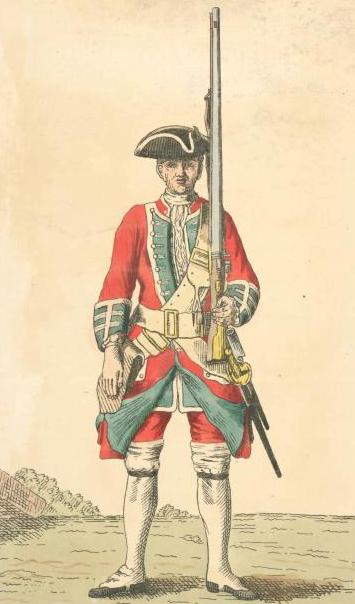
Whilst the wearing of such dark coloured tunics, typically worn alongside waistcoats and breeches, was customary during the early 18th century, one aspect of the uniform specific to the 39th was the notable inclusion of pea green facings. These generally refer to the visible inside lining of a soldier’s battle tunic or jacket, although they can also be used to describe the colours found on upturned cuffs and lapels. Utilised by soldiers to help identify friend from foe during the midst of battle, these distinctively coloured fabric linings became increasingly popular with European armies during this time period due to the evolving nature of gunpowder-based warfare and mass infantry formations. It is speculated that the inclusion of these pea-green facings acted as a signifier to the regiment’s historical raising in Ireland.
Other common clothing features include the adoption of white cloth gaiters and cravats paired with buff leather waist belts and widened chest straps or cross-belts. Leather pouches of varying sizes could be attached to these belts to hold musket ammunition; particularly useful in times of inclement weather! Additionally, gold braided lace commonly adorned the exposed trimmings around the neck, shoulder, arm and chest areas, whilst black lace or silk ribbons were traditionally wrapped around white stockings and leggings to help keep them in place (normally just below the knee). Buckles were sometimes added to aid in this endeavour, but were not mandatory.
In terms of headwear, a tricorn hat made of beaver fur or black felt ornamented with white lace was common grenadiers had mitre-shaped has adorned with royal cypher/insignia often white colour. Records held at the DHC demonstrate that the cottage lace making industry was very active in Dorset in the eighteenth century.
Do join us for our next blog which will look at the developments of uniform in the 19th Century.
An interesting history. I feel that I have a somewhat obscure personal connection with your subject, as my father, Lionel Frederick Coote, a namesake of Colonel Richard served in the Dorset Regiment during World War 2. He was conscripted in 1940 and served with the 5th Battalion unitl demobilisation in 1945. He was wounded in the attack on Hill 112 in Normandy and invalided to the UK. He returned to his unit before it entered Cleve.
Hi Peter
Thanks for your kind comment and for flagging up your father’s connection to the Dorset Regiment. I wonder if he ever talked about the uniform, or kept it at home? Our volunteers are working on the next part of this history, so watch this space.
It is important to make a distinction between Officers’ and Soldiers clothing as they were of different qualities and procured in different ways.
Officers’ coats were of Superfine Broadcloth dyed scarlet, wheras soldiers’ were made from coarser Broadcloth dyed red with madder. C18th dyers made a clear distinction between the two colours, so I have never seen an example of soldiers’ coats being described as ‘scarlet’ in an an C18th primary source.
All C18th garments were handmade so that was hardly a distinction of Officers’ clothing, however theirs was made bespoke (i.e. to fit them individually). Soldiers’ clothing wasn’t made by ‘local tailors’ and they didn’t attach themselves to the Regiment. Given a Battalion consisted of anything from 500 – 1000 men and they had a new set of clothing annually that relly wouldn’t work. Theirs was made to standard sizes by ‘clothiers’ (a distinct trade to tailors) under contract to the Colonel of the Regiment, usualy via the Regimental Agent (a civilian contract manager / banker who dealt with ordering these things and their finance on behalf of the Colonel). Clothiers made garments to stock sizes, broken down into various sub asemblies which allowed them to use semi-skilled labour to make the indivdual parts. The clotheirs were usually based remotely, because they needed a lot of labour, often, but not always in London.
There tended to be a high proportion of former tailors in the Army because pay was notoriously bad and so a military life was an attractive alternative. Some would be employed as ‘Regimental Tailors’ but they didn’t usually make garments complete, rather making adjustments, repairs and adding trimmings, badges of rank etc.
The main garment of the C18th (and early C19th) soldier was the ‘coat’; the earliest use of the term Coatee I have found is 1823. Tunic didn’t come into usage until well into Victoria’s reign.
Ammunition pouches were issued from centrally held stores at the Tower and were of a single size for a given regiment in a given period; ammunition capacity was a key factor so commanders needed to know what supply their soldiers carried in action.
‘Facings’ refers to the collar and cuffs of the coat, linings were known as just that. Coloured linings were replaced by white (or Buff in the case of Regiments with Buff facings) by the Warrant of 1768.
In the military clothing trade the term ‘lace’ means a woven worsted tape rather than the traditional knotted lace used primarily for ornamentation of ladies’ dresses. Like so many trade terms it only had that secific meaning in the context of Army clothiers. Regardless, the materials for making soldiers clothes came from specific regions which specialised in such not from the county after which the Regiment was named. Despite bearing county titles since the 3rd quarter of the C18th most Regiments weren’t posted any wear their parent county and very often there was no obvious higher proportion of men from the region either.
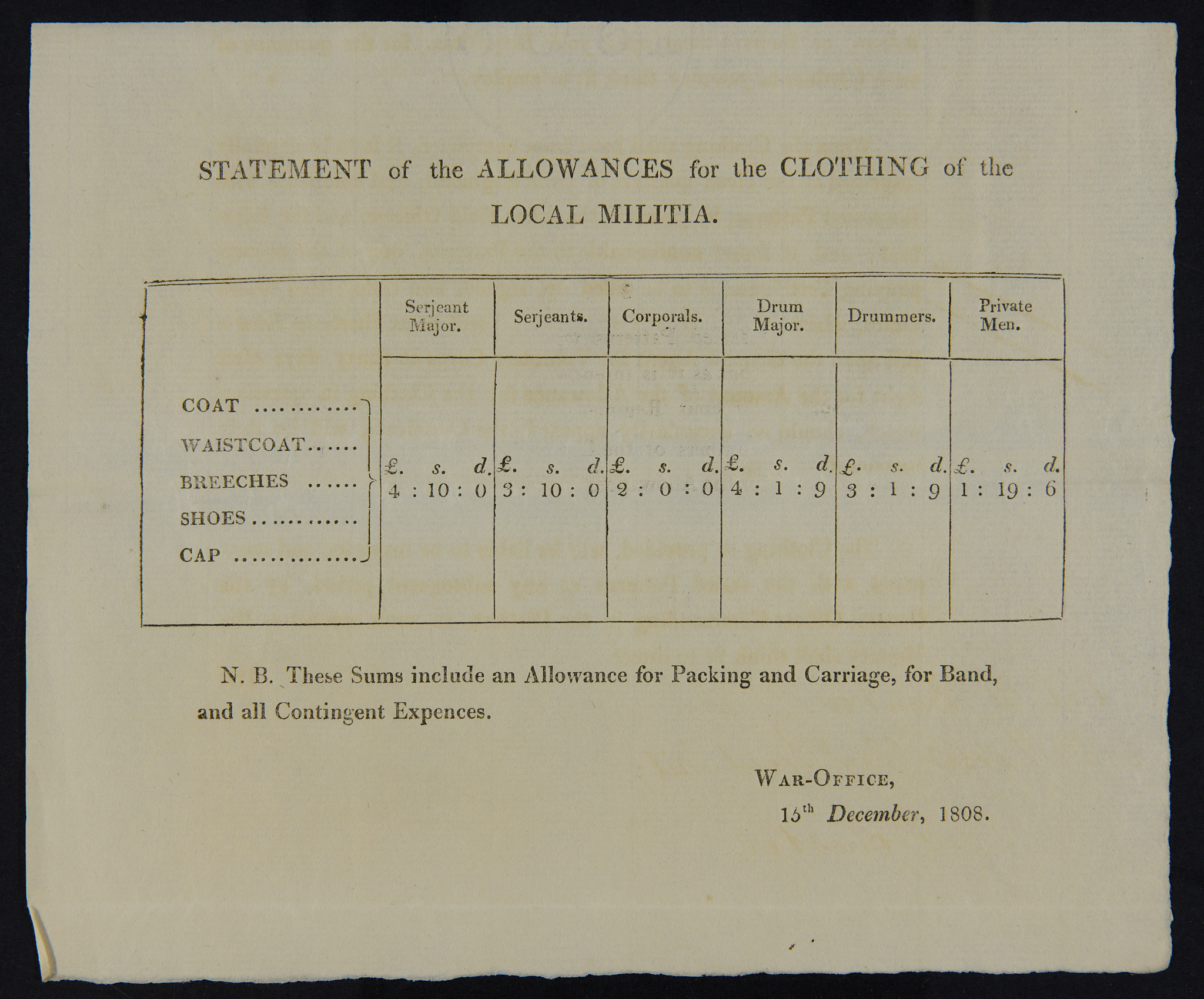
The Local Militia was a force which replaced the Volunteers raised in 1803; they were citizens who formed part-time units to guard their local area in case of French invasion. Their clothing was more often provided by local tailors, hence the allowance shown for paying for it. Some units consisted of very well to do people who were willing to pay considerably over the allowance for uniforms which their units had designed as embodiement of their civic pride. The design and procurement of their uniforms had very little in common with the Regular Army.
Until c1800 the headdress of most Infantry (less Grenadiers and Light nfantry) was a ‘cocked hat’; the term ‘tricorn’ is not a contemporary one.
Thank-you for all of this useful and interesting information. We will pass it along to the volunteer authors of this post who will be very interested to read it.