

The 18th century and the first half of the 19th century are often viewed as the ‘golden age’ of smuggling in Britain. During this period, Britain was involved in three major wars: the War of Jenkins’ Ear with Spain (1739-1748), the American War of Independence (1775-1783), and the Napoleonic Wars (1793-1815). To help fund these wars, Parliament introduced taxes, or ‘duty’, on certain goods leaving and entering the country. The list of taxable items was constantly growing, and often the duty due on these goods increased over time. This led to a boom in the smuggling trade, with ‘free traders’ (as the smugglers often called themselves) illegally importing a variety of goods to avoid these high taxes, including silk, lace, tobacco, brandy, chocolate, salt and tea.
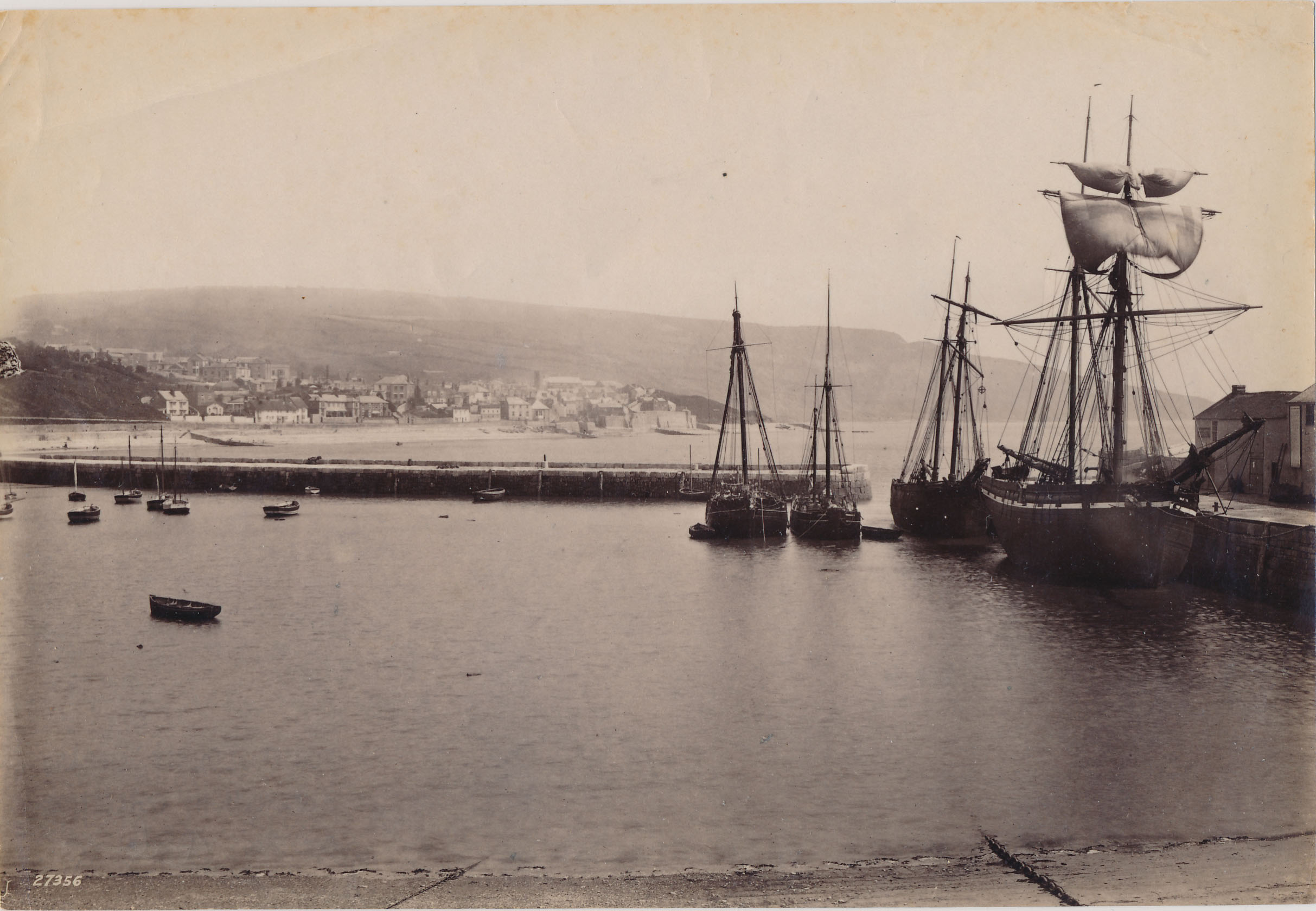
Many smugglers obtained their goods, like brandy and gin, from France and the Netherlands; so, with Dorset’s prime location on the south coast of England, it was a hotspot for smuggler activity. The coastal town of Lyme Regis was no exception to this illegal trade, and it was frequented by many famous smugglers, including Isaac Gulliver in 1776. Recently, we’ve stumbled across some interesting municipal documents from the Lyme Regis Borough Archive (DC-LR) regarding the seizure of various smuggled goods during the 18th century. These records are part of a volume of miscellaneous documents, compiled by C. Wanklyn in the 1940s (DC-LR/N/23/4).
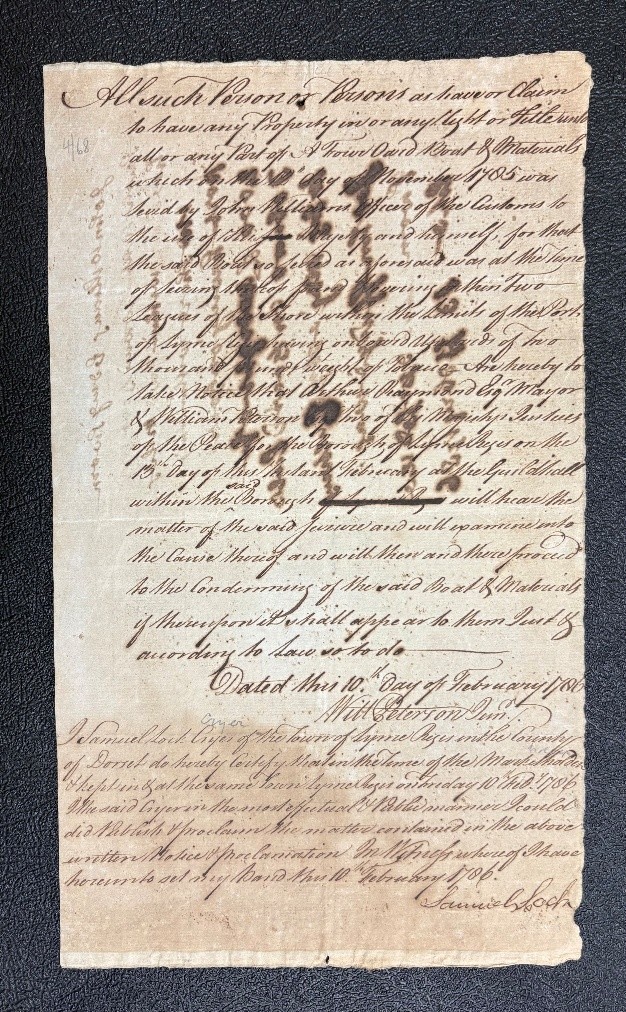
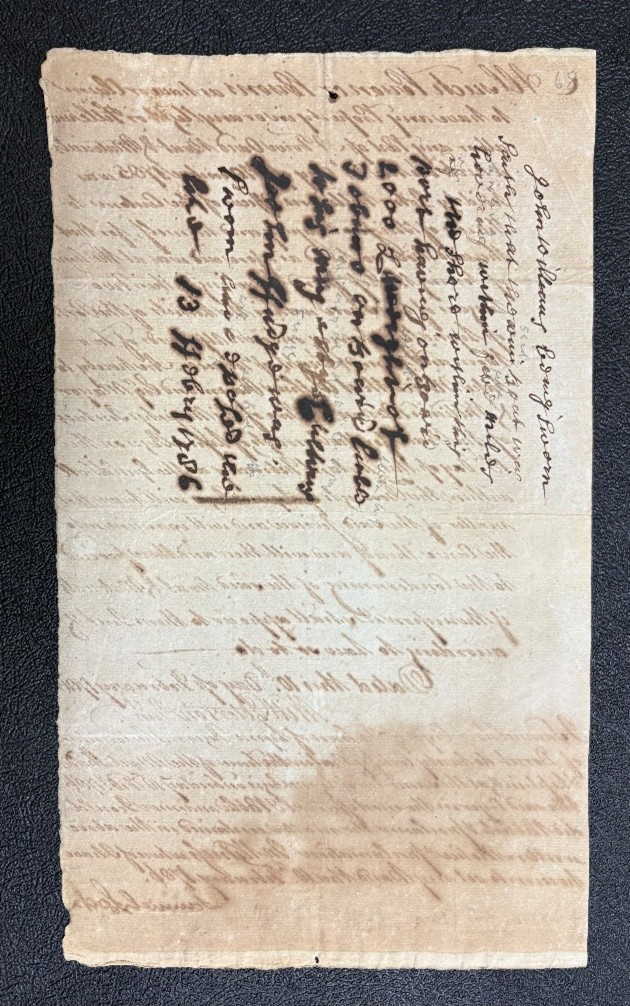
Many laws were introduced to try and prevent smuggling. One law, introduced in 1718 and amended in 1784, related to the act of ‘hovering’. A vessel was thought to be ‘hovering’ if it was seen operating outside of its licenced area. Additionally, the later amendment to this law meant that any vessel weighing less than 60 tons and carrying goods like brandy, tea, wine, coffee, etc. could be seized if it was found ‘hovering’ within three miles of the coast. An example of ‘hovering’ can be seen in the above document (DC-LR/N/23/4, folio 68), which relates the seizure of a four-oared boat by customs officer John Williams in November 1785. The boat was found hovering, without its owner, within 5 miles of Lyme Regis Harbour. Discovered on board the seized boat was over 2000lbs of tobacco, presumably waiting to be smuggled inland at an opportune moment when risk of discovery was low, such as on a dark moonless night.
You didn’t have to be a smuggler to be at odds with the law. Often smuggled goods could be found in the homes of people all throughout society. A great example of this is smuggled tea, with an estimated 90% of the population drinking two cups of tea everyday by 1768, most of which was likely brought into the country illegally. The following document (DC-LR/N/23/4, folio 31), details the seizure of a parcel of tea on the 31st of July 1732, from under the bed of Susanna Gaich of Lyme Regis.
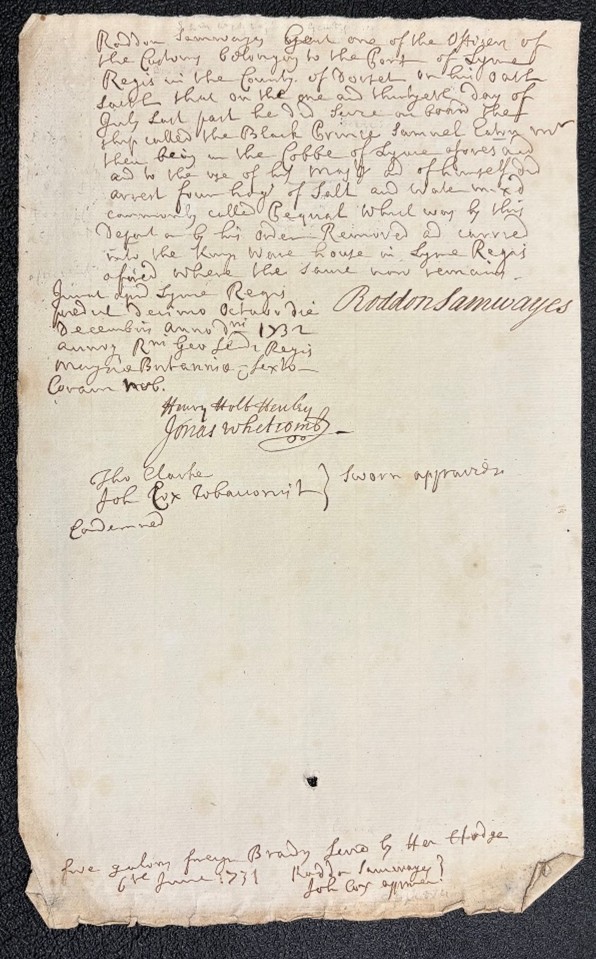
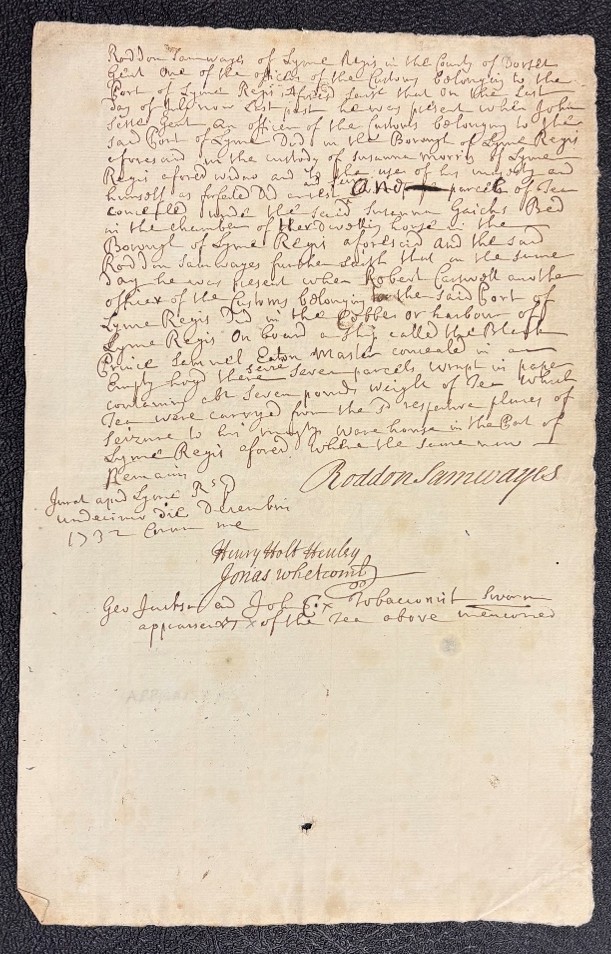
The 31st of July 1732 was also an unfortunate day for Samuel Eaton, master of the ship called ‘Black Prince’. Apprehended for smuggling in the Cobb of Lyme Regis, customs officers Rodden Samways and Robert Carswell stated they found seven paper-wrapped parcels, containing roughly 7lbs of tea, concealed in an empty hogshead cask on board this ship (DC-LR/N/23/4, folio 31). They also found a further four hogsheads of a salt and water mix referred to as ‘Pequal’ (thought to mean pickle). Both the tea and the saltwater mix were seized and removed to the King’s warehouse in Lyme Regis until it was decided whether it should be ‘condemned’ or not by the Justices of the Peace.
The account of the saltwater seizure (DC-LR/N/23/4, folio 30), shows that these goods were ‘condemned’. While no further details are provided on the outcome of this verdict, condemned goods were usually sold at a public auction or occasionally destroyed (though this was more commonly the fate of smuggled tobacco, which may have been burnt to discourage smoking). Seized ships may have also been sold at auction, alongside the contraband goods. However, the practice of auctioning off seized smuggling vessels did not last long, as it enabled the smugglers to buy back their ships and carry on with their trade. To prevent this, a law was passed stating that ships seized for smuggling were to be sawn into three parts. Unfortunately, the fate of the ‘Black Prince’ ship is not known.
If the goods were auctioned off, then the profit made from the sale would have been split between the Crown and the customs officer(s) who apprehended the smugglers, with a moiety (half), going to each party. As these customs officers would have received a relatively low wage, the promise of reward money for seizing smuggled goods would have motivated them, as the reward money from one large seizure of smuggled goods, condemned to be sold at auction, could sometimes even exceed an officer’s annual salary.
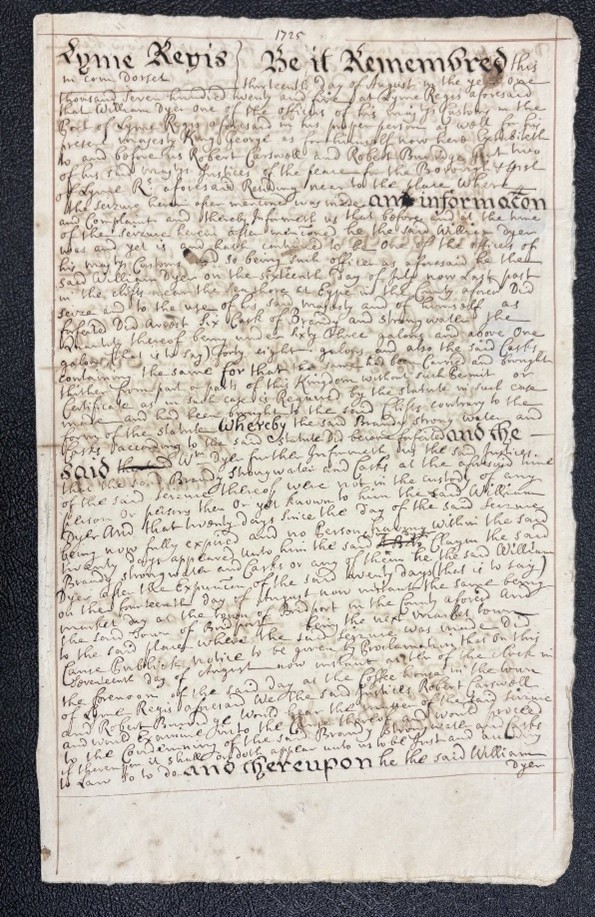
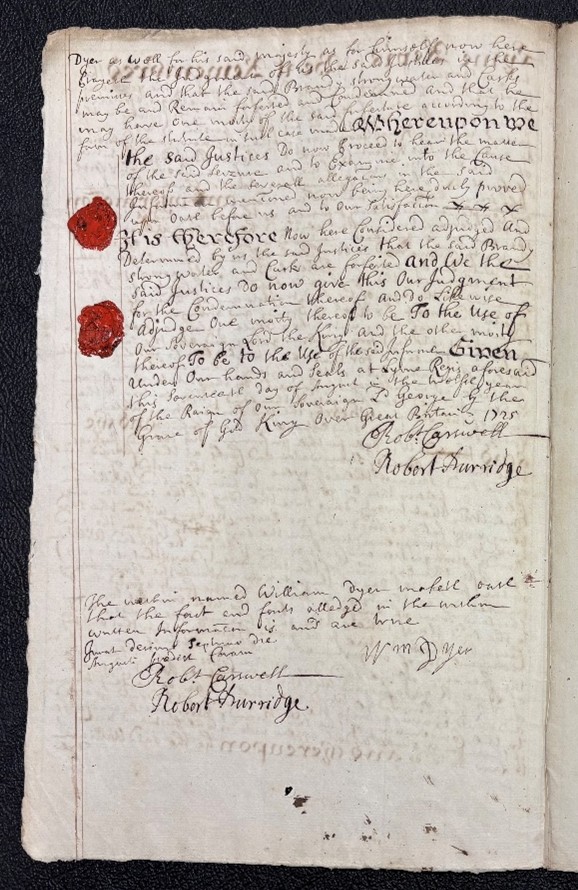
An example of this reward payment for the seizure of smuggled goods is shown in the above document from 1725 (DC-LR/N/23/4, folio 27). William Dyer, a customs officer for Lyme Regis, received a presumably good payday in August 1725, after he seized 6 casks of brandy hidden in the cliffs near the Eype coastline. Since no one had claimed ownership of this brandy within the 20 days following the announcement of its seizure by the town crier, this brandy was condemned to be sold at public auction, with…
‘…one moity thereof to be to the use of our Sovereign Lord the King and the other moity to be to the use of the said informer’
If you are interested in smuggling in Dorset, why not book an appointment to visit our searchroom to view our other Maritime Mischief documents, focusing on smuggling, shipwrecks and piracy: Maritime Mischief documents – Dorset Council