Now you might already know that Cromwell banned Christmas festivities, but did you know that he also changed the way marriages were registered? Less exciting, we know, but bear with us, because if you’ve been diligently putting together your family tree, and you’ve been able to get back to the mid-17th century, the ‘Act touching Marriages and the Registring thereof’ will likely have a big impact on the information (or lack of it) that you’ll be able to find.
So if you don’t already know, Oliver Cromwell came to prominence during the British Civil Wars, 1642-1649. In 1649, King Charles I was executed, and the Commonwealth was established. From 1653 until his death in late 1658, Cromwell ruled England, Scotland and Ireland as Lord Protector.
The keeping of a parish register – giving the names of those married and the date on which their marriage took place – had been required of ministers since 1538. But Cromwell’s Act touching Marriages, which came into force on 29 September 1653, radically altered this process.
In the first instance, it called for the appointment of officers, confusingly called ‘parish registers’, who would keep the records. They were to be elected, initially for three years, by parishioners, and sworn into office before a Justice of the Peace. The register did not have to be the minister or other church official, but just an ‘able and honest person’ of the parish. In the case of smaller parishes, registers were permitted to work across more than one.
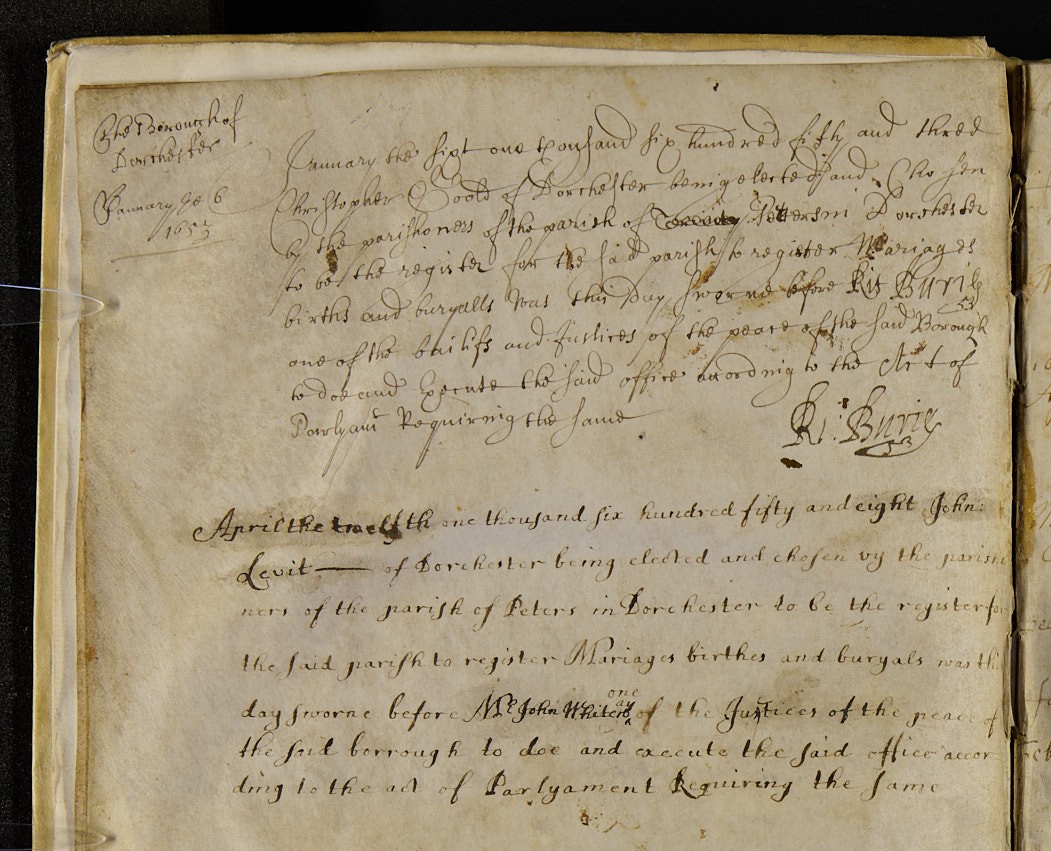
Here, in the register for St Peter’s parish in Dorchester (PE-DO[SP]/RE/1/1), we can see that Christopher Goold was appointed register for the parish on 6 January 1653/1654, and sworn in before one of the Justices of the Peace for the town. There are several other examples of these appointments in other Dorset parish registers from the same time.
Secondly, the Act stipulated that those intending to marry had to present themselves to the register (i.e. the appointed officer), who was responsible for publishing
‘the names, surnames, additions, and places of aboad of the parties so to be married, and of their Parents, Guardians or Overseers’
three times before the marriage could take place. The publication could be made in either the parish church or in the marketplace. Once this was done, the register would produce a certificate authorising the marriage.
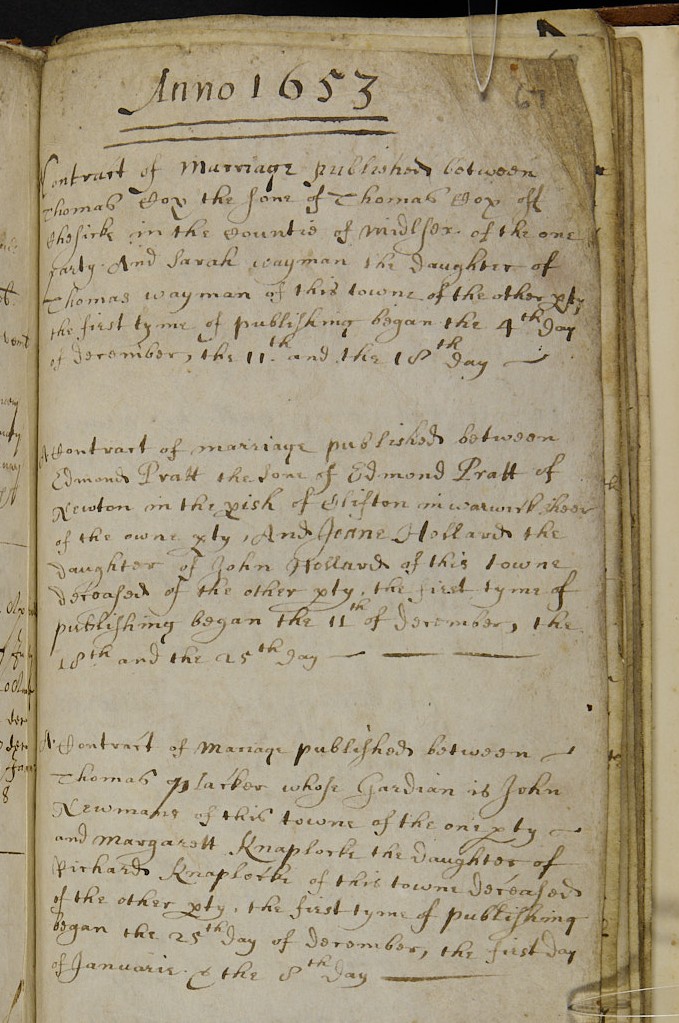
In this register from Melcombe Regis (PE-MCR/RE/1/2), all the entries concerning marriages from 1653 onwards begin ‘contract of marriage published between’ and go on to give the names of the couple intending to marry and the dates on which their ‘contract’ was published.
Thirdly – and most controversially – Cromwell’s Act took control of marriage from the Church and made it a secular institution. Rather than marrying before a vicar, couples were required to stand before a Justice of the Peace who would then perform a short ceremony in front of witnesses. The register was required to be present to record that the marriage had taken place.
In many ways, this made marriage easier by allowing any couple, no matter their faith, to obtain a valid marriage. But the requirement to go before a Justice of the Peace was also restrictive, because not every parish had a Justice readily available, meaning couples had to travel to neighbouring parishes to be wed.
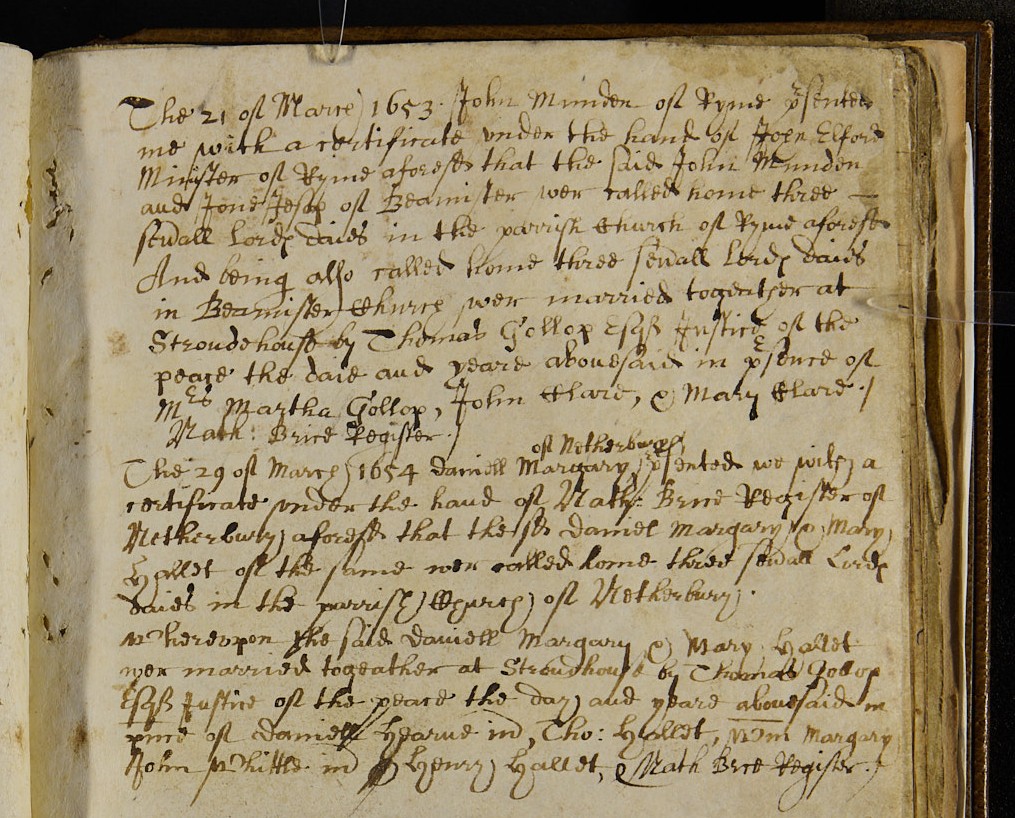
In this Netherbury parish register (PE-NBY/RE/1/1), marriages are recorded as having taken place at Stroudehouse [Strode House] before Thomas Gollop, Esquire, Justice of the Peace. Many of those being married are from outside the parish, and where this is the case the register Nathaniel Brice records that he has been presented with and verified certificates showing that their intentions to marry had been published in their home parishes.
So you might find, when looking at parish registers from this period, that there are no marriages recorded between 1653 and 1660 (when King Charles II was restored) at all. But if this is the case, you might want to have a look at the registers of neighbouring parishes as well. It’s possible the marriage you’re looking for was recorded there, if that was where the nearest Justice of the Peace lived.
Historians have previously thought that Cromwell’s Act was not well-observed across the country, but evidence from our parish registers would suggest that there were many parishes which took it seriously.
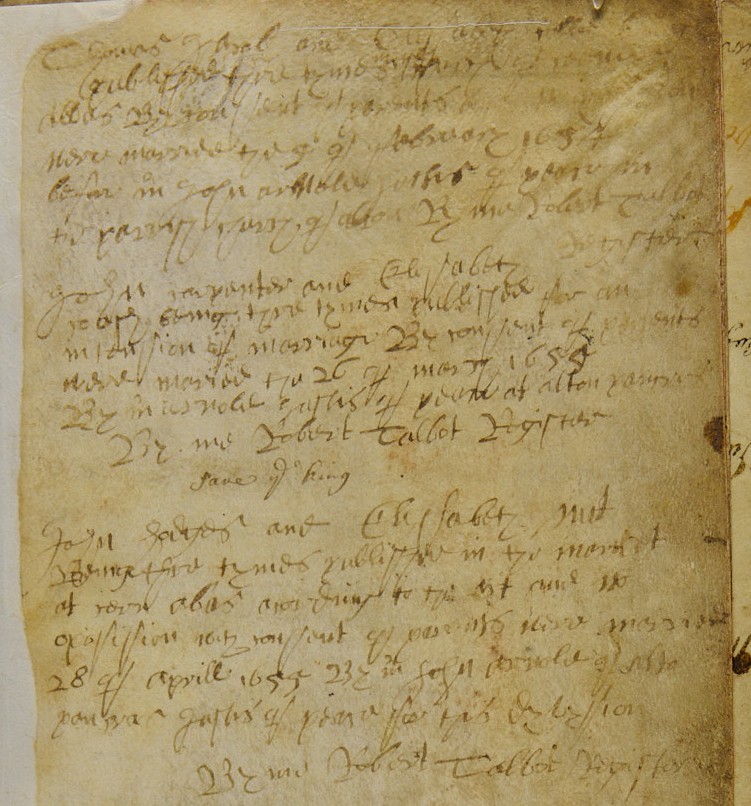
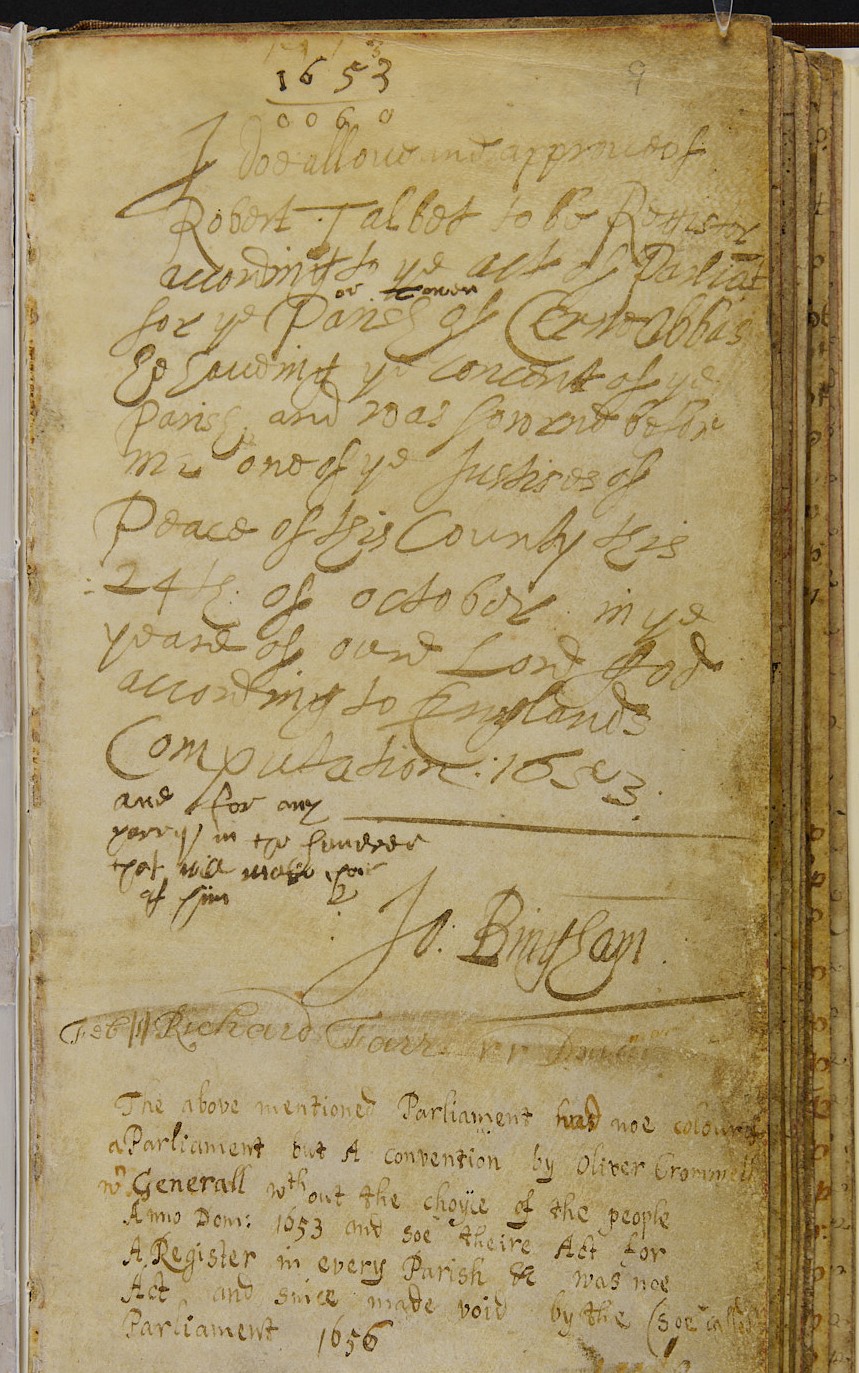
Having said that, in at least one of our parish registers, it’s clear that not everyone agreed with the Act (and no doubt there were many others who felt the same but did not record their thoughts!). In the Cerne Abbas register, underneath a paragraph of text recording the appointment of Robert Talbot as register in 1653, are a few lines written in the handwriting of the vicar appointed in 1658, which read:
The above mentioned Parliament had noe colour of
a Parliament but A convention by Oliver Cromwell
Generall w[i]thout the choyce of the people
Anno Dom: 1653 and soe theire Act for
A Register in every Parish was noe
Act and since made voide by the (soe called)
Parliament 1656
Perhaps even more controversially, under one of the marriage entries made in 1653, are written the words ‘save the king’. It’s not been possible to identify who wrote the words or when, but it’s safe to say that if they were written at the same time as the entry, the writer was risking a lot by committing his rebellious thoughts to paper!