

This is the second blog in a short series about our research into a copy of a book by William Lilly from 1666 that had been used as a notebook and doctors accounts book. In our first blog we explored the book’s connection with the Chaplyn family and how we established that the doctor who had written the majority of entries in the book was not John Chaplyn, but his brother in law Nathaniel Bartlett. In this blog we will tell you more about him.
As mentioned in our previous blog, our first clue towards the doctor’s identity came from an internet search, which led us to the website of the Royal College of Physicians. On this website there is an indexed transcription of Munk’s Roll or Inspiring Physicians, a biography of doctors created by William Munk in the 1850s, which includes an entry for a Nathaniel Bartlet, who practiced in Wareham and was made an Extra-Licentiate of the College of Physicians in London on 15 February 1685/6.
We already knew from the will of Ebenezer Chaplyn that his sister Dorothy had married a Nathaniel Bartlett, but we couldn’t be sure this was the same person, so we looked for more information.
We found a digital copy of a letter on the Royal Society website that was written to the society on May 13th 1697 from Nathaniel Bartlett of Priory House near Wareham. The letter is asking advice about the preparation of essential oil of roses and references Robert Boyle’s experiment with inflammable spirit of roses. The handwriting in the letter looks very similar to that in the diary and the address, Priory House, is where Dorothy Chaplyn, Nathaniel’s mother-in-law, was living when she made her will. This convinced us that this was the right man.
Trying to find out about Nathaniel’s family was more difficult. The lack of surviving records from Wareham was again problematic, but in Dorset we are very lucky to have an excellent OPC (online parish clerk) website where volunteers have transcribed many Dorset records and searching here led us to the transcription of the will of Elizabeth Melledge of Dorchester, which was proved on 21st June 1687. In this will she leaves £10 to her grandson Nathaniel Bartlett and £5 to his son John Bartlett. This corresponds with an entry in the book from 12th October 1687 recording income that mentions “my grandmothers legacies to me and sonne” and led us to conclude that Nathaniel was the son of John Bartlett and Martha Melledge.
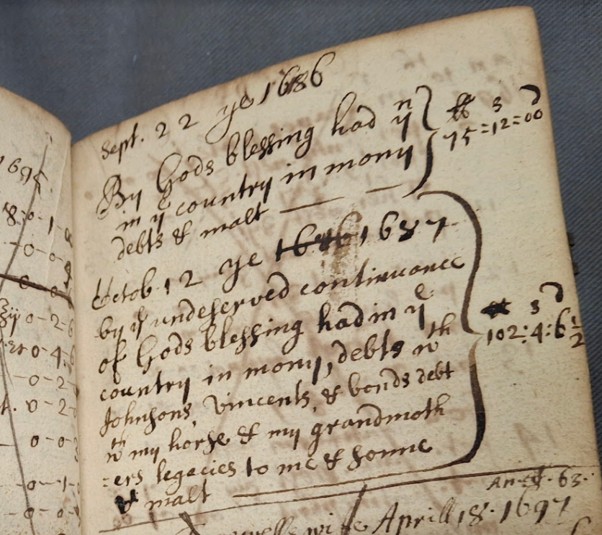
The medical accounts mention cousins with the surnames Bagwell, Vincent and Loop. Cousin was used quite loosely and didn’t necessarily mean that they were blood relations, but Bartlett was obviously close with these families. The Vincents were yeoman landowners from Povington and the Loop family appear on deeds from Wareham and Slepe where they are described as gentlemen and Nathaniel appears to have been of a similar social class.
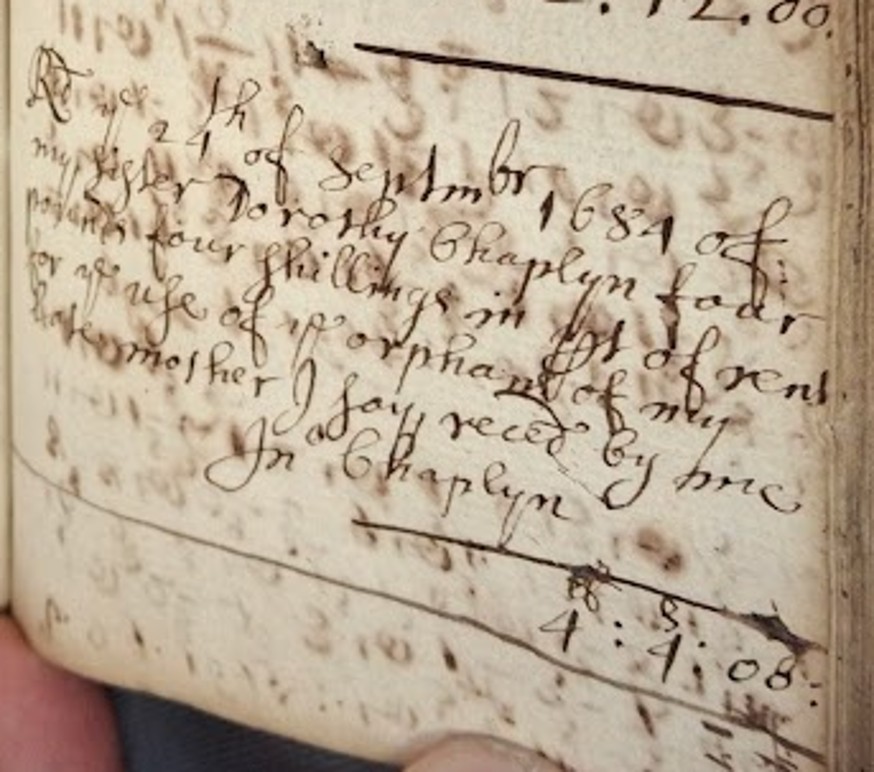
Dorothy and Nathaniel must have married between 1684 when John Chaplyn mentions his “sister Dorothy Chaplyn” in one of the notes contained within the book and 1686, which is the date of Nathaniel’s first entry.
The John mentioned in the will of Elizabeth Melledge in 1687 seems likely to have been John and Dorothy’s first born, but we have not been able to discover anything further about him.
The only other child we have been able to identify is a son named Nathaniel Bartlett. Dorothy Bartlett, Nathaniel Bartlett senior and Nathaniel Bartlett junior are mentioned in the Will of Joshua Wiseman of Wareham from 1703 and Nathaniel Bartlett of Poole is mentioned in the will of John Vincent of East Lynch, near Corfe Castle, from 1731.
Munk’s Roll contains a second entry for a Nathaniel Bartlett of Wareham, admitted an Extra-Licentiate of the College of Physicians 9th June, 1713 so it is very likely that Nathaniel followed in his father’s footsteps. He is probably also the Nathaniel Bartlett of Poole who married Judith Trew of Wareham at Lytchett Matravers on 16 March 1713/14 and is almost certainly the same Nathaniel Bartlett, MD, of Poole Dorset, who corresponded with Sir Hans Sloane in 1726 in a letter held by the British Library.
We have not been able to find any other records that are definitely linked to the family and have not been able to establish when Nathaniel died or if he had any other children.
There is an Oldfield-Bartlett family who are prominent in Wareham in the 1800s, but the pedigree given in The History and Antiquities of the County of Dorset by the Reverend John Hutchins, who lived in Wareham and was acquainted with the family, does not tie in with any of the family information we have about Nathaniel.
We also found a notice in the Salisbury and Winchester Journal dated October 29th 1768 asking after a Nathaniel Chaplett Bartlett of Poole, who hired a black gelding to travel to Wareham and then rode off with it towards Ringwood and disappeared. Nathaniel is described as being
“about five Feet seven Inches high, has a stiff neck, with a patch on the same, his head leaning to his left shoulder, wore a light Drab fly Coat, with his hair tied back, and had a Gentleman-like Hand, having been brought up to no Trade”
It was quite common for people to give their children their grandmother’s maiden name as a middle name, and we wondered if Chaplett could be a corruption of Dorothy’s maiden name Chaplyn. This, combined with the mentions of Wareham and Poole made us think that this could be a grandson of Nathaniel and Dorothy, but the only other document that contains this name is a militia list from Poole from 1759 that gives no further information, so this is just speculation.
We have found out as much as we could about Nathaniel Bartlett’s family. Look out for our third and final blog in this series to find out more about his patients and medical practices.
Thanks for the information. Do I have this right – the book was kept by Dorothy the mother from 1668 at the latest; after her death, Dorothy the daughter kept it at Pryory House, recording transactions in her mother’s estate as co-executor with her brother John, who occasionally signed receipts in the book for money distributed from the estate?
The Pryory House near Wareham is at East Holme, according to OPC, which is extra-parochial – maybe a haven for a dissenting family. You pointed out the Chaplyn malting house in Wareham, and the 1672 meeting house, and a note of a sale of a house in 1668, but Dorothy’s will doesn’t specify any real estate – I wonder if it’s possible to piece together the family’s property dealings in reaction to religious uniformity. Did the residence at East Holme date from a return to the Wareham area after the death of Thomas Chaplyn at Cambridge, coinciding with the 1668 sale, and was the move to Cambridge in reaction to the Five Mile Act 1665?
I find it odd that the wife/widow of a strict Presbyterian minister (d.1667) would keep an astrological almanac in 1666/68. And why go to the trouble of a burial in the chancel of Lady St Mary’s, when her will expresses no preference? I guess her excommunication came after the will was made, which then raises issues about the relationship between the executors and the rector and patron of LSM. I think Calamy says somewhere that the church itself was suspended for a time over this controversy.
Too many questions. Sorry!
The earliest handwritten note in the book is from 1667 or 1668. The contents of the note suggest that this may have been written by Dorothy, the wife of Thomas Chaplyn, but we cannot be 100 percent certain of this.
The next dated entries are signed by John Chaplyn and relate to payments to his sister Dorothy, so either the book had been taken by him, or, as you suggest, it was kept by his sister and she made him write the notes as a receipt.
The location of Pryory House is something that has puzzled us. We have seen the entries on the OPC locating it in East Holme, but we have not found any documents confirming this. It is possible that the person who wrote the entry on the OPC has found documents that we have not yet discovered, but there is another possibility.
There was a Priory House in Wareham that was adjacent to the Churchyard of St Marys and in the deed we hold for this property from 1790 (D-SEN/16/2/5) it mentions that there is also a malthouse there. Although within the modern town of Wareham the house officially lay within the Parish of Stoborough, which would explain the address being written as ‘near Wareham’.
We have not found any documents to prove that this was the address where the Chaplyn family lived, but if it was it would make a lot more sense that Dorothy Chaplyn’s children wanted her buried in St Mary’s Churchyard, right next to their house.
It does not explain why a presbyterian family owned a book of astrological predictions and we suspect that we will never be able to answer that perplexing question. To find out more about the fascinating contents of this book look out for the last blog in the series, which will be appearing at the end of November.
If you have any further questions about this, or any of our other documents, feel free to email us at archives@dorsetcouncil.gov.uk and we will do our best to answer them.
Thanks for responding – much to think about.