

At Dorset History Centre, we were delighted to have the opportunity to archive the records of Wessex Water and its predecessor companies. With the contract running until April 2027, this has now been a work in progress for us since Spring 2025 and is overseen by our archivist, Emma Blowers, assisted by Collections Assistant, Chris Scriven. In all, we received well over 100 archival boxes of documents in addition to having 14 drawers in our repository filled with maps and plans belonging to the collection.
These documents take us back to the very roots of public water supply in Dorset and include bound copies of the 1797 Parliamentary Act confirming the formation of the Company of Proprietors of the Weymouth Waterworks who first provided water to the town from the Boiling Rock spring in Sutton Poyntz.
Modernisation was quick to arrive with the initial gravity-fed system being superseded by a pumped supply in the 1850’s. The collection includes the contract with Mr John Leather for the developments that made this possible along with what is presumed to be his own notebook on the works.
During this earlier period, when not overseen by Urban or Rural District Councils or Corporations, water supply came via small, localised companies with sewerage being the responsibility of the Councils and land drainage overseen by river authorities.
The collection allows us to trace developments as companies were created, merged or dissolved with a view to attaining the government agenda of transforming the business from a localised affair to a regional structure that unified these three functions.
To this end, Wessex Water itself was formed from 99 different companies as one of ten regional boards in 1974 before being privatized in 1989.
Like all histories, it has its tensions, such as the failed attempts of the Weymouth & Melcombe Regis Corporation to acquire the undertaking of the Weymouth Waterworks during the mid-1930s. The collection includes public information posters encouraging people to vote against the Bill resulting in the supply of water remaining with a private company as opposed to transferring to public hands.
There are also tales of what might have been, such as the Central Dorset Water Order 1964 which sought for the undertakings of the boards covering the Weymouth, Portland and Dorchester areas to be transferred to the West Dorset Water Board. This Act met with stiff opposition and was never passed. A principal concern was that it would result in an increase in water rates within urban areas if they were amalgamated with the harder to reach (and therefore more expensive to supply) rural areas surrounding Bridport.
These were often contentious issues and were certainly newsworthy events. The collection contains associated press cuttings dating back as far as 1885 from publications including The Southern Times and The Dorset County Chronicle, including an article from the Chronicle in relation to the Bill of 1897 that sought to extend the limits of supply covered by the Weymouth Waterworks.
There are also many interesting documents besides the legal. There are significant amounts of correspondence from and in relation to the Second World War including letters relating to evacuation, bomb damage and air raid precautions as well as a written exchange with Colonel Bridge in relation to military plans.
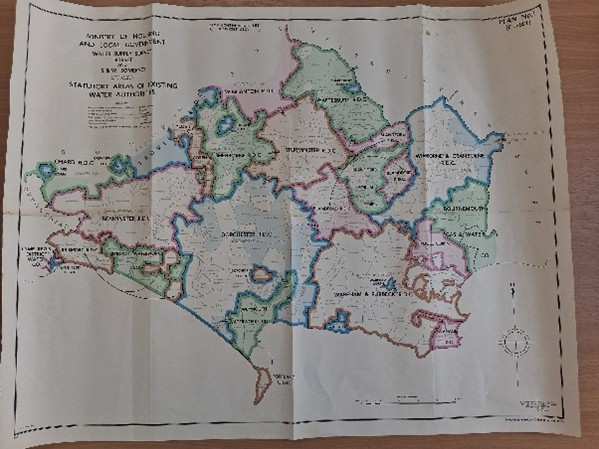
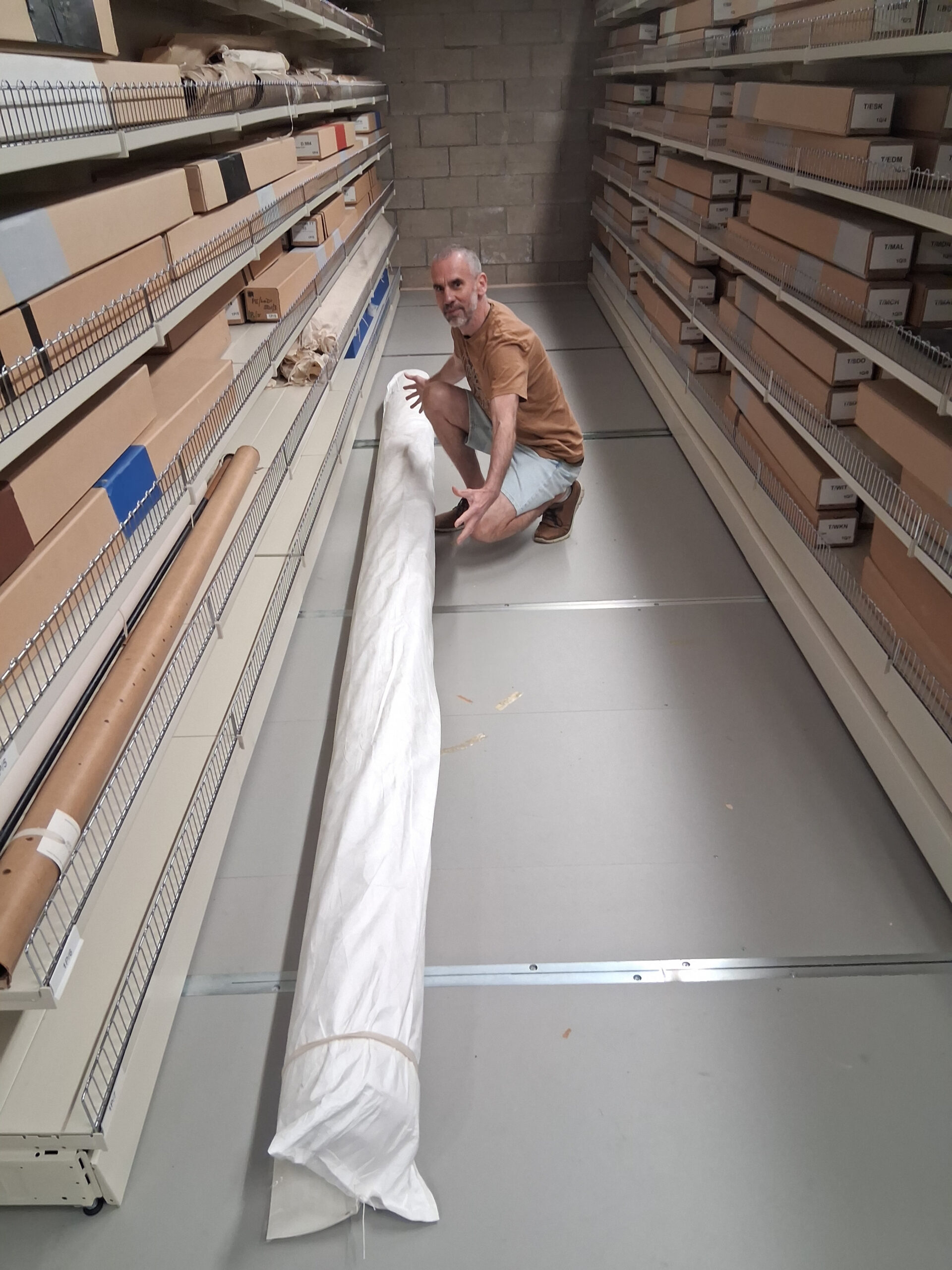
The range of maps and diagrams is extensive. Some of the maps can be quite large and the most sizeable in the collection is over 4m squared! We are also lucky enough to have inherited architectural plans for the current town bridge in Weymouth as the water supply lines ran under the harbour where the bridge is constructed. The collection also includes sets of architectural drawings for many of the local pumping stations and reservoirs.
Not all the documents arrived with us in pristine condition and there is plenty of work for our Archive Conservation Officer, Jessica, in terms of their restoration; removing mould, repairing tears and the bindings of volumes to ensure each item is available and safe for the public to handle for decades or even centuries to come.
For now, work continues with the expectation that the catalogue will be made available to the public at the end of the project in April 2027. As well as being of practical relevance in some instances, we hope that the collection will capture interest and be widely viewed.