

One of the more unusual recent acquisitions by the Dorset History Centre is a slim 20 page booklet entitled ‘The Shapwick Monster’. At a price reflecting its rarity, it fell to the auctioneer’s hammer earlier in the year for £440 with help from the Dorset Archives Trust, the charity whose members support the work of the History Centre. Slightly battered and time-worn, as befits something not far short of 200 years old, it was first published in 1841 by Frederick Clemence, a Blandford bookseller and stationers whose premises were in Salisbury Street.
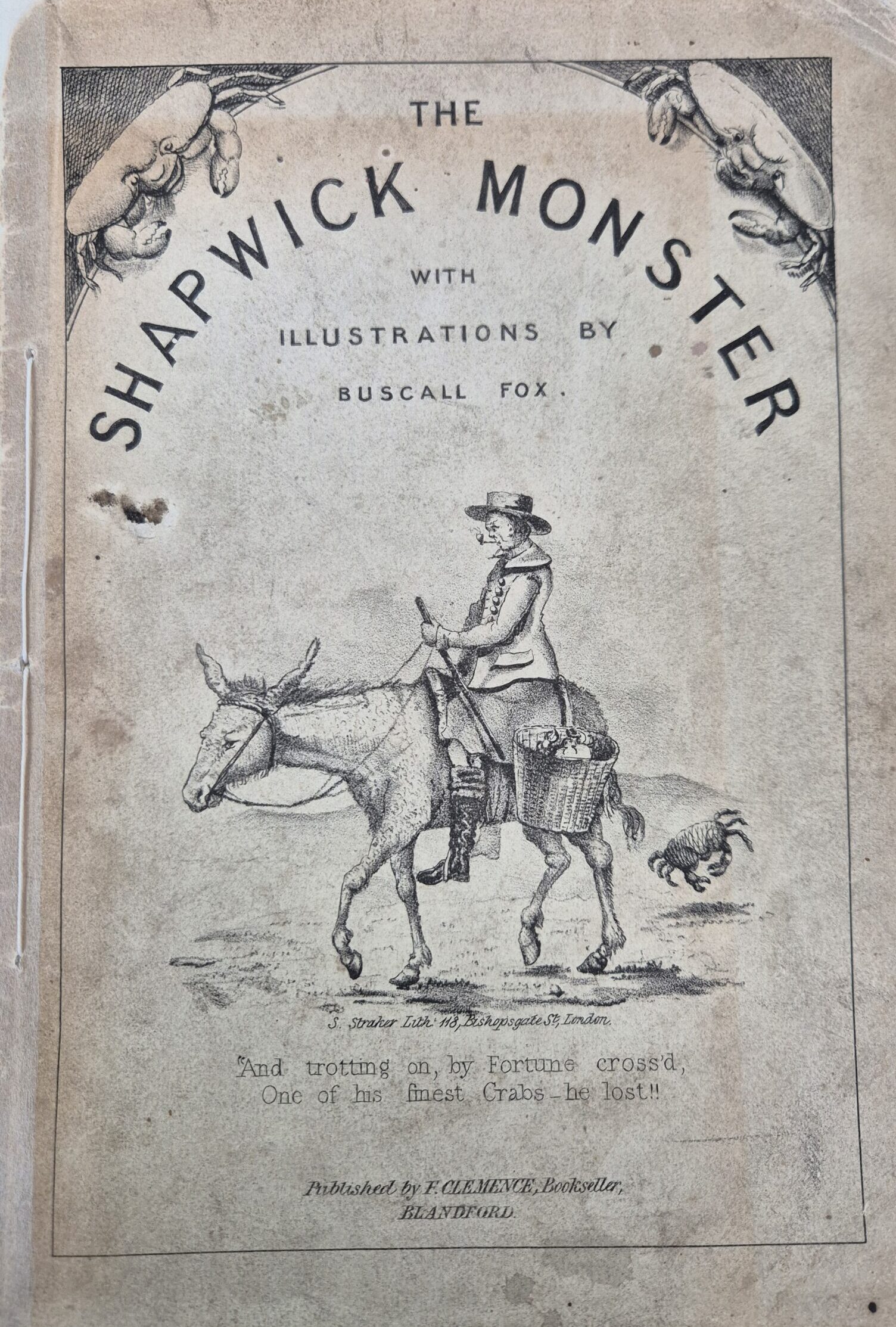
The author of this unlikely folk tale was a young man called Buscall Fox (1818-1887), the son of a Norfolk farmer, who turned the fable of the monster into an illustrated poem whilst lodging with Mary Harrington and her family in Sturminster Marshall. Fox was a student at the Royal Academy Schools and a pupil of John Frederick Herring, a prolific painter of horses and hunting scenes. Only a few of Buscall Fox’s own paintings survive, and these days he is best known for the comic verse and accompanying illustrations in ‘The Shapwick Monster’, of which only a handful of copies are thought to remain. The event Buscall Fox describes reputedly took place on an October day in 1706 when a travelling fishmonger from Poole accidentally dropped a crab whilst bound for Bere Regis.
‘T’was Eve, — The Sun was going down
When from his work, a country clown,
Trudging along in simple nature,
By chance trod on the crawling creature.’
The ‘country clown’, a farm labourer from Shapwick, had never seen a crab, and hurried home to tell all who would listen that he had spotted a crawling monster. Armed with pitchforks and sticks the villagers hurried off to drive away the strange creature, ‘with hook-ed claws upon his feet, all, / And pincers like a great Black-beetle!’
The crab would have none of it. A stand off followed, ending when the villagers decided that the only person who might be able to identify the monster was an old bedridden shepherd, who with some nervousness and much grumbling agreed to inspect it.
The shepherd was placed in a wheelbarrow, wheeled to where the crab had taken refuge, and on spotting it cried:
‘Tis a Land Monster! — Wheel me off!’
And terror-struck, exclaimed again,—
‘Wheel off! — Wheel off! — or we’re all dead Men!’
At which point the fishmonger returned in search of his crab, calmly picking it up and popping it in his basket. The villagers were horrified, ‘Take care! — he’ll bite! — You’ve caught the Devil!’. Gradually it dawned on the fishmonger that the dim-witted folk from Shapwick had never seen a crab and hadn’t a clue what it was:
‘You silly fools! Can it be true,
A Fish so common, you don’t know?
This is a CRAB, caught in the Sea
This morning it was lost by me.’
Once word spread the people of Shapwick were regarded as being a bit simple and were much laughed at when buying fish at local markets. Today the tale is commemorated by a weathervane showing the villagers chasing the crab on the roof of the aptly-named Crab Farm. The great collector of Dorset folklore, John Symonds Udal, describes a ‘Shapwick Monster’ as a byword for something ‘too extraordinary to be explained’. The story itself is surely an unlikely survival of an oral tradition handed down from one generation to the next until the 23-year-old Buscall Fox, kicking his heels in his Sturminster Marshall lodgings, picked up pen and ink and turned it into verse.
—
This was a guest blog written for Dorset History Centre by David Burnett, a member of Dorset Archives Trust. The Dorset Archives Trust welcomes new members and encourages anyone with an interest in Dorset’s history to join. For more information go to www.dorsetarchivestrust.org