

Welcome to our third blog looking at regimental uniforms. If you have missed them, our blogs looking at the 18th Century and 19th Century are available to read elsewhere. This time we are going to look at developments from 1899 until the Dorset Regiment merged with the Devonshire Regiment in 1958.
Although the 1st Battalion of the Dorset Regiment stayed in India, the 2nd Battalion was shipped to South Africa to fight the Boers (1899-1902). The British army found it necessary change the standard-issue field clothing to better suit conditions in South Africa. Consequently, the uniform transitioned from scarlet wool to the 1899 pattern khaki drill; a more practical, lightweight cotton drill uniform. The jacket had a stand-up collar and pointed pocket flaps. The trousers were high-waisted and sometimes tapered, for wearing with boots. Heavier khaki wool serge jackets were introduced for South Africa in 1899. These were basically essentially khaki copies of the standard red undress frocks. The main headwear consisted of the white foreign service pith helmet (often dyed or covered with a khaki cloth) and the folding forage cap or slouch hat.
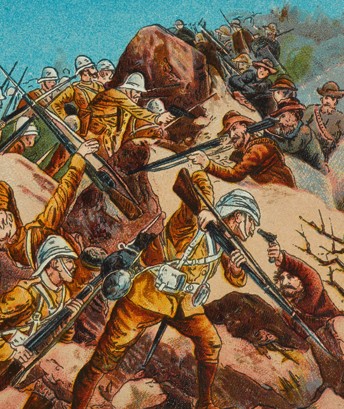
The Dorsets never really liked the white facings introduced in the 1881 reforms and appealed to the War Office for a return to the traditional green. The 39th Foot had worn pea green since 1742 and the 54th Foot had worn grass green since 1755. After proving their worth in India and South Africa, the regiment finally got their way. In 1904, King Edward VII granted the regiment permission to abandon the “standard” white and adopt grass green as the official facing colour, thus restoring some of their traditional identity.
The Dorset Regiment’s post-Boer War ceremonial uniform included a scarlet tunic with distinctive grass-green facings, dark blue trousers with double yellow stripes and a traditional brass-spiked Home Service helmet. The cap badge still featured the Gibraltar castle and key (from the 39th) and the silver sphinx (from the 54th) was worn on the green collar. The more practical khaki service dress was introduced for active duty. Green remained the regiment’s signature colour until the regiment was amalgamated in 1958.
The standardisation of uniforms for active service continued. In WW1, the Dorset Regiment wore the standard 1902 British Army khaki field service uniform. All enlisted soldiers were also issued with heavy wool greatcoats for cold and wet weather; only officers were allowed to wear the belted trench coat. The Dorsets were able to maintain their identity via regimental brass buttons, “Dorset” on the shoulder titles and the Castle and Key of Gibraltar cap badge.
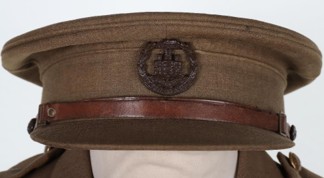
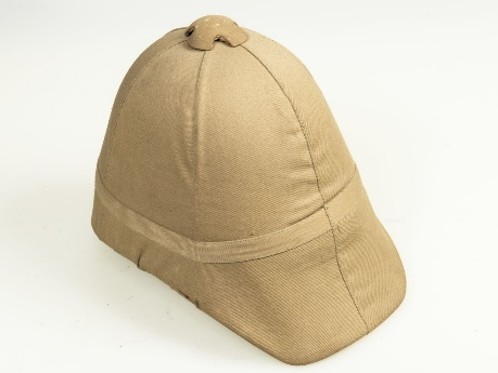
The Dorset Regiment served in the hot climate of Mesopotamia during WW1, necessitating protection from sunstroke. To adapt to the conditions, the Wolseley pattern pith helmet was adopted. This was a high-domed cork helmet with a wide brim to shade the eyes and the back of the neck and a ventilated top. There was a cloth band known as a puffaree around the base of the pith helmet. To preserve regimental identity, the Dorsetshire Regiment affixed a small cloth patch, in regimental colours, to the side of the helmet.
From 1915 onward, and particularly during the Battle of the Somme in 1916, the steel Brodie helmet replaced the cloth cap in order to protect against shrapnel and bullets.
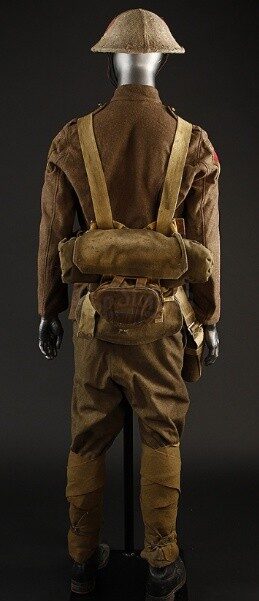
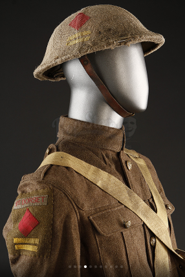
Another of the standardised changes to uniform was the 1908 pattern webbing system, designed to meet the current military’s needs. This was seen as an improvement over the 1888 leather Slade Wallace equipment (deemed to be unsuitable for holding modern ammunition.) The 1903 Royal Commission’s review on the war in South Africa heard that the Slade-Wallace equipment was “an absurdity,” “cumbersome, heavy and badly balanced”. In other words, it was outdated.
The main difference was that the webbing was made of woven cotton canvas. This was very durable, able to withstand wet weather and easy to repair, unlike leather. This meant that the equipment lasted longer. The 1908 system distributed the soldier’s load evenly across the body and was adjustable, for the wearer’s comfort. Ammunition capacity was increased to five or ten pouches so that troops could carry up to 150 rounds per person. The kit also included an adjustable belt, braces, a small pack (which was used to carry rations, socks and personal items), an entrenching tool, a water bottle carrier and a bayonet frog. Although a big improvement, some changes were still needed; downward facing flaps were introduced for the second pattern, to stop bullets falling out. Overall, the 1908 webbing pattern is seen to have been very successful and made a significant contribution during the First World War.
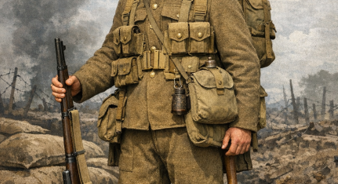
After World War I, the Dorsetshire Regiment transitioned from strict wartime trench gear back to traditional garrison uniforms. Over the following decades, their uniform evolved alongside the rest of the British Army, gradually swapping heavy wool for practical, modern combat clothing. Before the First World War, scarlet red coats were briefly worn off-duty. Post WW1, with the exception of the Royal Horse Artillery and the Household troops, full dress was not usually restored and was generally confined to bands and guards of honour. In the interwar years, this traditional red coat was permanently withdrawn for the ordinary soldier, though officers retained their ceremonial scarlet and gold mess dress.
During WW2 (1939 – 1945) the regiment adopted the 1937 pattern battle dress; a short, woollen blouse (top) and high-waisted trousers. This was much better suited for movement and mechanical warfare. Battle gear tended to be specialised according to the operational needs. For the invasion of Normandy and the subsequent campaign in Burma, helmets were covered with netting and hessian for concealment. Following 1945, there was a brief return to standard, uncamouflaged olive-green and khaki uniforms.
In 1951, the unit’s title was officially shortened from the Dorsetshire Regiment to the Dorset Regiment, and their cap badge was redesigned to reflect this change. Then, in 1958, the regiment merged with The Devonshire Regiment to form The Devonshire and Dorset Regiment, part of the Wessex Brigade. This meant that the collar dogs, buttons and cap badge needed to change. However, in 1969, the Wessex Brigade was broken up. The Devonshire and Dorset Regiment regained its independence and returned to its own cap badge, based on the pre-1958 design.
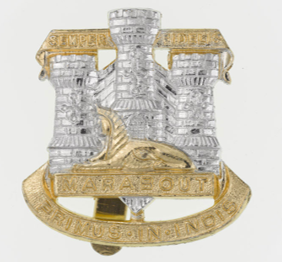
The new unit’s badge featured a Sphinx above the battle honour ‘Marabout’ superimposed upon Exeter Castle. The motto ‘Semper Fidelis’ (Always Loyal) is visible above the castle and ‘Primus in Indis’ (First in India) below.
The unified Devonshire and Dorset Regiment was later absorbed into The Rifles in 2007.
—
Sources:
https://collection.nam.ac.uk/detail.php?acc=1998-07-27-53
www.nam.ac.uk/explore/dorsetshire-regiment
https://bid.candtauctions.co.uk/lot-details/index/catalog/101/lot/33226/WW1-British-Cuff-Rank-Uniform-Grouping-of-a-Captain-in-the-Dorsetshire-Regiment
https://propstore.com/product/war-horse/british-dorset-regiment-uniform
https://www.gettyimages.co.uk/photos/british-pith-helmet
https://paddelaters.com/blogs/1908-pattern-webbing-set-the-load-carrying-system-of-ww1-britain
https://www.iwm.org.uk/collections/item/object/30076295
https://collection.nam.ac.uk/detail.php?acc=2001-07-67-1
https://www.nam.ac.uk/explore/devonshire-and-dorset-light-infantry
“Discovering British Military Uniforms” by Arthur Taylor
—
This was a guest blog written for Dorset History Centre by volunteers Andrew and Julie. If you are interested in writing a guest blog, please get in touch: archives@dorsetcouncil.gov.uk